
The Priority of Potential — Spotting Talent for our Organizations

Potential!, Miles Goodhew, Flickr

Photo Credit: Potential!, by Miles Goodhew, Flickr

In a previous post I highlighted 8 Core Leadership Abilities. In the same HBR article, Claudio Fernández-Aráoz engages the important theme of how to spot talent in the 21st century.

A History of Talent Searching

Over the centuries and years, diverse approaches have emerged for identifying leadership and managerial talent. Fernández-Aráoz identifies this progression around four movements:

Focus on Physical Attributes — Those who were fittest, healthiest, and strongest.

Focus on Intelligence and Experience — Those who were the most intelligent, most experienced, and those with the best past performance.

Focus on Testing for Competencies— Those who possess the right set of characteristics and skills associated with predicted job performance.

Focus on Potential  — Those who are ready to engage the VUCA environment of Volatility, Uncertainty, Complexity, and Ambiguity.

Why Potential

In the VUCA world of increased volatility, uncertainty, complexity, and ambiguity, there are new demands on prospective talent. Fernández-Aráoz discusses the factors of globalization, demographic shifts, and challenges to the talent development pipeline. The talent development pipeline is significantly stretched due to increased competition in this changing environment of the 21st century. These factors are forcing organizations to focus on identifying potential (not just track-records of success), and then developing and retaining this talent in the years ahead.

What to Look for When Looking for Potential

So, how is potential spotted? What qualities are the hallmarks of such potential? Fernández-Aráoz identifies the following hallmarks for spotting talent and potential in the 21st century:

Motivation — “…a fierce commitment to excel in the pursuit of unselfish goals.”

Curiosity — “…a penchant for seeking out new experiences, knowledge, and candid feedback and an openness to learning and change.”

Insight — “…the ability to gather and make sense of information that suggests new possibilities.”

Engagement — “…a knack for using emotion and logic to communicate a persuasive vision and connect with people.”

Determination — “…the wherewithal to fight for difficult goals despite challenges and to bounce back from adversity.”

How to Develop those with Potential

Because spotting potential is quickly becoming the new norm, developing this potential talent in our organizations is becoming the highest priority. How are motivation, curiosity, insight, engagement, and determination built upon so that individuals with potential translate into individuals with performance?

Fernández-Aráoz identifies the priority of stretch development. On this point Fernández-Aráoz notes, “when it comes to developing executives for future leadership assignments, we’re constantly striving to find the optimal level of discomfort in the next role or project, because that’s where the most learning happens.” Finding stretching assignments, where those with potential don’t immediately have all the answers, is one of the chief pathways in moving individuals from potential to performance.

______________________________

How are you identifying potential around you? How are you developing this potential into performance?

Visionary Change with a Plan: Remembering the Importance of Effective Management in the Change Process

Change, SomeDriftwood, Flickr

Photo Credit: Change, SomeDriftwood, Flickr

Change agendas often fail due to good visions that lack a thoughtful plan. I observed this in some of my previous work with smaller nonprofits. In these contexts, leadership energy was devoted to generating new ideas and visions for the future but there was not sufficient managerial energy devoted to plans that would support the enactment of vision.

Doing things Right

Peter Drucker noted that management is doing things right while leadership is doing the right things. Although leadership is focused on doing the right thing and casting appropriate visions for change, it is often management that focuses on doing things right. Change initiatives that are launched but not sustained often fail due to lack of effective planning and lack of doing things the right way.

Consistent with Drucker’s observations, John Kotter highlights the central functions of leaders and managers. Leaders focus on setting direction, aligning people, and motivating people. In contrast to this, managers plan and budget, organize and staff, and control and problem solve. Successful change efforts are not focused on only one of these lists, but rather both. Successful change efforts are not focused on leadership or management, but rather effective leadership and effective management.

Change Initiation and Change Implementation

Since leadership tendencies of setting direction often initiate change agendas, it is easy for change failure to occur in the absence of management. Without leadership, change fails due to lack of initiation. Without management, change fails due to lack of implementation.

What change vision are you pursuing as a community? Are you pursuing both effective initiation and implementation? How are you pursuing the change visions with a plan?

Leading from the Front … Leading with Vision

Leadership vs. Management, on Flickr

Photo Credit: Leadership vs. Management, on Flickr

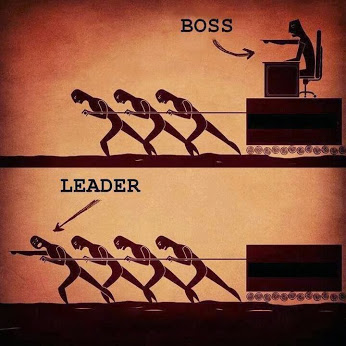
Leading from the front requires leading with vision!

Engaging the question, “Why does vision matter?” Burt Nanus offers the following reflection:

Vision is the main tool leaders use to lead form the front. Effective leaders don’t push or production their followers. They don’t boss them around or manipulate them. They are out front showing the way. The vision allows leaders to inspire, attract, align, and energize their followers—to empower them by encouraging them to become part of a common enterprise dedicated to achieving the vision.”

In this brief post I encourage you to consider whether you’re leading from the front or whether you’re leading from behind. Are you calling people to an inspiring vision of what can be, or are you pushing and prodding followers to do what they really are not committed to already?

Vision helps to motivate followers intrinsically rather than extrinsically. Vision helps to lead from the front!

Follower Motivation and Leader Humility

Humanity, Love, Respect (B.S. Wise, Flickr)

Photo Credit: Humanity, Love, Respect, by B.S. Wise, Flickr

The challenges leaders face in developing motivation and empowerment among followers are many.

There may be challenges in the interpersonal or dyadic relationship between individual leaders and followers. There may be challenges within the team or group environment at any of the forming, storming, norming, or performing stages. There may be challenges at the level of organizational systems within which leaders and followers are embedded. Or, there may be challenges external to the organization such as a difficult economic environment straining follower and leader expectations of performance.

Beginning with Leader Self-Reflection

While each of these levels may be challenges to motivation and empowerment, leaders should begin by considering their own role in leadership challenges. In a previous post I argued that Effective Leadership = Effective Self-Leadership. When leaders face challenges in motivating and empowering followers it is important to first look to themselves as leaders—to begin seeing how they personally may have contributed to demotivating followers. The Bible makes this priority personal: “Why do you see the speck that is in your brother’s eye, but do not notice the log that is in your own eye?” (Matthew 7:3).

As a leader,
are you prone to look first to the proverbial speck in a follower’s eye,
or the log in our own eye?

Avoiding the Fundamental Attribution Error

In challenging times it is easy to look to others or our environment and assign fault to them. This tendency is described by some as the fundamental attribution error or actor-observer bias. But thoughtful leaders are self-reflective leaders. They resist the fundamental attribution error and consider how they personally may be contributing to a problem and how followers may be impacted by their environment. They are leaders willing to look first to their contribution to a situation and work out from there to other relevant contributing factors.

Desiring Personal Humility

In light of such logic, we might argue that the greatest challenge to motivating and empowering followers is me and you. It is about self-reflection and self-leadership first. Jim Collin’s notes this point in his book Good to Great. At the heart of Collins’ work is the concept of level five leadership. Collins describes Level Five Leaders as having a unique blend of both professional will and personal humility. With such a blend, a leader has the self-confidence and self-efficacy to own that they do not have all of the answers and that they have less control than they may have originally thought. They also are willing to look into the mirror and see what their contribution is to the lack of motivation among followers.

Pressing Forward with Personal Humility and Follower Motivation

As leaders engage in personal reflection, embrace a spirit of humility, and acknowledge their own contribution to challenges … powerful result emerges. Rather than thinking less of leaders, followers generally grow in their respect for leaders who demonstrate authenticity and a willingness to own their part in challenges. Along this path, leaders begin by truly recognizing where actual power lies—with the wider organizational membership and not just leaders. From this place, leaders are able to motivate followers in authentic and meaningful ways. This motivation may take the form of genuinely valuing and developing people. It may also take the form of channeling followers to orient their attention on vision and performance that matters to them and the organization.

_______________________________

Leader self-reflection and humility is a key starting point in making such motivation and empowerment come to life. Have you seen positive examples of leader humility in your organizations? What impact did this have on the community and the overall motivation experienced by organizational members?