The Web of Work: Serving and Being Served through Work

Web, david reid, Flickr

Web, david reid, Flickr

Have you paused recently to reflect on how interdependent we are in our work and within an economy? For those with independent streaks, this question might be received as insulting. But I mean this in the best sense of interdependence. No-one truly is independent. We rely upon countless others throughout our day, and others rely upon us.

Work, at its core, is the means by which we serve one another in a society and an economy. Through my work I contribute to society and make myself useful to others. And through the work of others, I am served countless times throughout my day. And lest we miss this, work has both paid and unpaid expressions. From a parent working at home to care for children, to those serving in paid positions, our work—paid and unpaid—is most often the primary way we serve others.

Work becomes a beautiful web or network of service.

My Work of Serving Others Today

My work today happens to involve traveling to a conference. Because of this, my work for the day is fairly straightforward. First, I’m using time on the plane to (hopefully) serve you the reader of this blog through my work of reflecting on the meaning of work. Second, I’m going to a conference that will allow me to gain insights for my role as an academic administrator so that I may better understand how I to serve the students enrolled in the doctoral program I lead.

So this particular day, I hope that the recipients of my work are you and my doctoral students. Through my work (some of it paid and some of it unpaid), I am serving others today.

The Work of Others Serving Me Today

But the web of work does not end there by a long shot. It is barely lunchtime as I write this, and I have been served by innumerable individuals who have served me through their work.  Though I will certainly miss countless categories, consider with me the multitude of individuals who have already served me today through their work before I have even reached the lunch hour.

Waking Up

  • The furniture makers who made the bed I slept in
  • The home builders who made the home in which I live and woke up
  • The inventors and manufacturers who developed the alarm clock used to wake me

Preparing for the Day

  • The workers who made the modern conveniences of a shower, toilet, and sink
  • The product developers and distributors who make simple toiletries available so I may shave and brush my teeth
  • The clothing designers, manufactures, and laborers involved in the creation and distribution of the clothing I am wearing today

Traveling to, from, within, and in between Airports

  • The countless individuals from Henry Ford on involved in providing a reliable Ford vehicle for me to drive to the airport this morning
  • The massive number of individuals who participated in the planning, construction, and maintenance of the roadway and traffic network facilitating a smooth drive to the airport
  • The countless number of engineers, builders, and beyond involved with constructing and maintaining the parking ramp, elevator, trams, escalator, restaurants, concourses, restrooms, jet ways, tarmacs, runways, and airplanes I have encountered and relied upon today
  • The technology experts involved in bringing smartphones, computers, monitors, and avionics involved in my work and transportation today
  • The many airport and airline employees who helped with scheduling, checking in, loading bags, fueling planes, boarding, serving passengers on the plane, flying, navigating, and those attending to safety through air traffic control

Brightening the Day — Back to the Individual

And while I’m missing an endless number of categories and individuals who have served me today through products and services provided and used—even though I have never met most of them—sometimes we have the chance to get to see the person serving us and greet them by name.

One of those individuals was Gwen. Gwen served me through her work today by brewing and handing me my coffee this morning at the airport. Though a small act, Gwen brightened the early morning at the start of my travel with kindness and caffeine. While she is just one individual, Gwen reminds me that the countless number of others who served me today through their work also have names and faces.

Work and Economy is about People

At the end of the day, economy and work are not just about money, labor, and exchange. Economy and work are ultimately about people and how these people contribute to the well-being and flourishing of others. In a modest way, I’m serving people through my particular work today. In exchange for this modest commitment to serve others, in return I have been served by thousands, if not millions, through the products and services that have facilitated my work and travel today.

In light of this, I am grateful. I’m grateful for the opportunity to serve others through my work. I’m grateful for other people who likewise serve me through their work. Work provides a network of service. Work, in a very real way, becomes the glue that holds us together as a society.

An Invitation to Recognize and Value People in Their Work

So, I invite you to pause in the midst of your day.

Pause and recognize how you are serving others in your work today, both the paid or unpaid dimensions of your work. Pause and recognize how others are serving you through their work (again, paid or unpaid). Be grateful for these observations. Be grateful for these people. And, allow this thankfulness to spill over into expressions of grace and gratitude as you interact with others in your day. We live in a delightful Web of Work.

Let Your Life Speak — How to Understand Your Vocational Call

Artist at work, Jean-Francois Phillips, Flickr

Artist at work, Jean-Francois Phillips, Flickr

How do you discern your vocational path? How do you decide what your contribution to the world will be? What is your vocational calling?

These are big questions. How we understand our work and the contribution we make to the world is vital from our earliest days of vocational discernment on through adulthood.

  • It is vital for teens as they consider potential pathways for further education and future work.
  • It is vital for adults as they work to make ends meet for their family, and particularly as they seek to do so in a manner that is fulfilling to them personally and meaningful to others societally.
  • It is vital to all engaged in any form of vocation because our work lives occupy the majority of our waking hours.

Understanding the importance of vocational discernment is one thing. Understanding how to approach this process of vocational discernment is quite another.

How to Engage in Vocational Discernment

As I have spent time teaching in the area of leadership and the inner-life, one of the core principles I come back to with students time after time is a rather simple one—the importance of listening. At the core of vocational discernment is the art of listening.

1. Listening to Heroes and History

In the book of Hebrews we are instructed to “Remember [our] leaders, those who spoke to [us] the word of God. Consider the outcome of their way of life, and imitate their faith” (Heb. 13:7). This charge to look to our leaders is not simply referring to the contemporary and living, but rather also to those who have gone before us.

In Hebrews chapter 11 the author highlights over a dozen persons of great faith such as Abraham, Sarah, Moses, and David. Reflecting on their lives, we are instructed: “Therefore, since we are surrounded by so great a cloud of witnesses, let us also lay aside every weight, and sin which clings so closely, and let us run with endurance the race that is set before us” (Heb. 12:1).

As we look to such stories of courage and faith, this becomes one pathway of listening for our own vocational discernment. What is “the race that is set before us”? As we run our own race, we have “so great a cloud of witnesses” surrounding us and cheering us on. Some of these are individuals we read about in Scripture. Some of these are courageous individuals we read about in other historical literature. We can learn about our own vocational race as we look to others. We can reflect on our life and calling as we consider the lives and callings of those throughout history. Historical examples, for better or worse, provide thoughtful insights for our own vocational discernment process.

2. Listening to Your Community

Not only can we engage in vocational discernment through listening to heroes and history, we also must learn to listen well to those in our immediate communities. Are we listening to our family, our friends, and maybe even our foes as we consider our vocational path? There is great value in a contemplative approach to vocational discernment (something I will highlight below), but calling is often best discerned not in isolation but rather in the context of community.

Are we listening to the voices around us? Are we listening to the perspectives of supervisors? Are we listening to feedback from coworkers and those who work for us? Are we listening to what our friends and family share? Are we listening even to our critics when they bring constructive rather destructive reflection?

In the context of community we find a place to listen to others in our own vocational discernment processes.

3. Listening to Your Life

In his book Let Your Life Speak, Parker Palmer points us to an old Quaker saying that became the title of his book—let your life speak.

Speaking to Your Life

Parker begins his reflections by contrasting two approaches to life. I’ll call the first approach speaking to your life. On this approach, Parker writes, “Vocation, the way I was seeking it, becomes an act of will, a grim determination that one’s life will go this way or that whether it wants to or not.” This is the path many pursue for understanding and seeking their vocational goals.

This path is characterized by setting our course, clarifying our values, and identifying and implementing things such as our S.M.A.R.T. goals. Certainly there is a place for these principles.  But Parker is pointing us to something more. He refers to this something more as letting your life speak.

Let Your Life Speak

Rather than planning out and dictating to our life, Palmer reminds us of the importance of listening to our life and letting our life speak to us. Parker writes, “Vocation does not come from willfulness. It comes from listening. I must listen to my life and try to understand what it is truly about—quite apart from what I would like it to be about—or my life will never represent anything real in the world, no matter how earnest my intentions.”

Such insights remind us of the value of contemplative reflection. They remind us of the importance of stopping, listening, and paying attention to what is happening in and through our lives. Though contemplation is not the only solution, it is a particularly important message for this season in time and history. There are so many potential distractions around us. Although contemplatively listening to our lives has always taken intentionality, in the days of smartphones, email, Facebook, and countless other barriers to contemplation, we are reminded that listening to our lives takes focus and intentionality.

4. Listening to God

For persons of faith, listening to God is the most important consideration. Understanding and living out God’s will for us is a primary concern, and a conversation for which the biblical authors provide key insights (e.g., Romans 12:1-2). While the discussion of understanding God’s will and listening to God’s heart for us warrants a substantial treatment, at this point I’d simply like to make the connection between listening to God’s voice and what has been noted above.

Listening to voices from history, voices from our community, and the voice of our own life are some of the primary ways we hear the voice of God in our lives. The biblical phrase “it seemed good to the Holy Spirit and to us” (Acts 15:28) reminds us that through seasons of discernment and prayer, often the will of God is discerned in the context of the communities within which we are placed.

Certainly God can speak in very direct and dramatic ways. Moses experienced this in the burning bush of Exodus 3. But more often, we hear the voice of God in quiet ways through the people, events, and circumstances that shape our life. We tend to hear God more like the “gentle whisper” Elijah experienced (1 Kings 19:11-13) than the burning bush Moses experienced (Exodus 3).

What’s Next — Moving from Listening to Action

While listening is often the headwaters of discerning vocational calling, action is also important. Engaging the question “How do you get where you want to go,” Michael Hyatt reminds his readers of the importance action: “Just start. Once we had our direction all that was left was to move toward it. … Clarity is composed of knowing and doing.”

As most can affirm through their life experience, sometimes the best way to figure out what is vocationally fulfilling is to experience a number of options. As you “try on” these vocational options, what is a good fit for your skill set and gift mix? What is consistent with your personal passions and purpose? What options are also aligning with opportunities?

While vocational discernment begins in contemplation, it doesn’t end there. Find a rhythm of moving between contemplation and action. There is a cyclical or helical relationship between reflection and action where contemplation gives birth to behavior, and those actions once again lead us back to further reflection.

What Has Worked for You?

As you’ve engaged in your own vocational discernment journey, what has been the key for you? What acts of listening have been of help to you? What other steps do you recommend for those engaged in their own vocational discernment process?

Leadership, Work, and the Priority of Purpose

Purpose Logo, leesean, Flicker

Purpose Logo, leesean, Flicker

Purpose matters. As evidenced by the popularity of Rick Warren’s The Purpose Driven Life—a book that has sold over 30 million copies—people have an innate desire to know that their lives matter and that their lives are shaped by a sense of purpose. One CEO, Dave Dillon, expressed it this way: “All human beings want to find meaning in their lives.”

Purpose and Leaders

While purpose is a priority for all human beings engaged in all types of work, purpose holds unique importance for leaders. Why is this? Leaders have an important role to play in shaping the culture and direction of the organizations they lead. Will this culture and direction be shaped by an anemic vision of life and organizational purpose, or will it be shaped by a vital sense of purpose and mission that connects to something larger than themselves and contributes to the flourishing others?

Engaging the importance of purpose for leadership, Bill George, former CEO of Medtronic, asks the following questions: “What is your True North? Do you know what your life and leadership are all about, and when you are being true to yourself?

Personal and Organizational Purpose

Although this begins with a personal sense of purpose for leaders, this “True North” purpose is vital at both the personal and organizational levels. Does the leader personally have a sense of purpose guiding their life? Does the leader also see a greater sense of purpose in the work organizationally? Understanding purpose at both the personal and organizational levels is vital for leaders and followers alike.

Theologically-Based Purpose

Amy Sherman provides thoughtful reflection on purpose and vocation in her book Kingdom Calling: Vocational Stewardship for the Common Good. In discussing the core of Christianity Sherman writes: “The gospel of the kingdom tells us not only what we’re saved from, but also what we’re saved for. We have purpose, we have a sacred calling, we have a God-giving vocation….”

In other words, God has made, shaped, and redeemed our lives for a purpose. The Bible reminds us that “we are his workmanship, created in Christ Jesus for good works, which God prepared beforehand, that we should walk in them” (Ephesians 2:10). Because of the gospel, our lives are not only moving away from something but our lives are to be oriented toward and for something as well.

Practically-Effective Purpose

Not only is purpose in work and leadership a theologically grounded idea, it is also practically effective and backed by a growing research base. In another post I highlighted the work I’ve been doing with the Purpose in Leadership Inventory (PLI). Along with additional leadership variables such as goal-orientation and follower-focus, the variable of purpose in leadership is showing strong statistical relationships with other important variables. Purpose in leadership—a leader’s sense of personal and organizational purpose—is significantly related to leadership effectiveness, follower job satisfaction, follower organizational commitment, and follower sense of person-organization fit.

Identifying Your Purpose

Amy Sherman argues that our vocational sweet spot is found at the center of three domains: (1) God’s priorities, (2) personal passions and gifts, and (3) the world’s needs. Understanding this vocational sweet spot goes a long way in understanding one’s purpose. Bill George makes a similar affirmation arguing that “following your passions will enable you to discover the purpose of your leadership.”

Understanding your purpose as a leader is not simply about personal fulfillment. Understanding your purpose and how this relates to the organization you serve shapes the lives of others. Leader purpose helps followers to be more satisfied in their work, have a better sense of their fit in the organization, and have increased commitment to their work and to their organization.

Taking the Next Step with Purpose

So what is your purpose? What is the “True North” that guides you in your life, work, and leadership? Whether taking to time to read a book such as Bill George’s True North, or engaging with a peer or coach who may help you better clarify your vocational sweet spot and sense of purpose, purpose needs to be a priority. Take time to prioritize reflection on purpose in your life, leadership, and work in the coming days.

Easter, The Gospel, & Virtuous Leadership

black and white cemetery christ church

Photo by Pixabay on Pexels.com

Easter week is just around the corner as I write this post. At the heart of Easter is the message of the gospel. In this brief post, I’d like to make some connections between the core message of Easter and leadership practice.

Ethics matter for those working at diverse organizational levels. But ethics especially matter for leaders.

We want to know that what our leaders say is true. We want to see that the actions of our leaders are consistent with what they say as leaders.

General Ethical Approaches

Though certainly an oversimplification of ethical theory, we can argue that there are three primary approaches to ethics:

  • Virtue Ethics
  • Duty Ethics
  • Utilitarian Ethics

Here is a brief overview of these approaches drawn from an article I wrote with a colleague:

  Virtue Ethics Duty Ethics Utilitarian Ethics
Key operational question Who ought I to be? What ought I to do? What brings the greatest happiness to the greatest number?
Definition of Happiness Fulfilling one’s purpose or function Adherence to moral absolutes Maximization of pleasure, absence of pain
Focus Character of the individual Rules and resulting obligations of the individual Outcomes and consequences
  • A utilitarian approach to ethics bases decisions on what brings the greatest happiness to the greatest number.
  • A duty-based approach (or deontological approach) to ethics bases decisions on what one ought to do.
  • A virtue-based approach to ethics bases decisions on who one ought to be.

The Priority of Virtue Ethics

While there are supporting arguments for each of these ethical paths, I find that the most effective form of ethical practice is grounded in virtue-oriented approaches. Why is this?

In times of crisis and ethically challenging circumstances, people will tend to do what is natural to them. They will act in accordance with who they are. Because of this, the most powerful approach to ethics is one that takes seriously the formation of ethical people at a level of virtues and character.

Though we need moral guidance (a deontological and duty-based approach), the capacity to act on this comes from moral fortitude (an ontological and virtue-based approach).

Virtuous leadership requires virtuous leaders. Ethical leadership requires ethical leaders.

Because of this, a foundational question in this discussion is how does one become a virtuous person/leader?

The Gospel and Virtue Ethics

I don’t want to imply that only Christians may be virtuous leaders. Certainly, we can all think of Christians we know who have not acted virtuously and those of other non-Christian commitments who do act virtuously.

I do want to emphasize that the Christian gospel provides a powerful answer to the question of how one becomes a virtuous person/leader.

At the heart of Easter is the gospel. The gospel centers on the person and work of Jesus Christ. Jesus’ death on the cross, remembered in the heart of Holy Week, is at the center of the Christian faith. Jesus died on a cross to pay the penalty for sinful people and to restore wholeness to our broken world. Those who trust in Jesus’ work on their behalf are offered forgiveness for their sins and are welcomed into both God’s family and God’s mission of restoring and healing a broken world. At Easter, we celebrate not only Jesus’ death, but also his being raised to life three days later to demonstrate His power over sin and death.

So How Does this Relate to Virtue-Based Leadership?

The gospel is not about good, moral, or virtuous people offering themselves to God. The gospel is about sinful, immoral, and broken people being made new by Christ’s work in their lives.

We can never be good enough, moral enough, or righteous enough to make ourselves right before God. Only God’s work in us by the gospel can do that.

What does this mean for a Christian approach to virtue ethics?

Rather than seeking to be virtuous in order to make ourselves right before God, in the gospel we yield to the God who is able to make us right before him.

The gospel does not lower the ethical bar. The gospel does not say that sin and unethical leader behavior doesn’t matter. Rather, the gospel gives us a pathway for changing us from the inside out. The gospel gives us a hopeful path on which we can start to see change. The gospel gives us a credible answer to the question of how one may become a virtuous person/leader.

The answer is not in our own virtuous behavior, but rather in looking to the God of Easter who is able to do in us what we are not able to do ourselves.

4 Benefits of Teams

"A group of people with hands joined", by DG EMPL, Flicker

“A group of people with hands joined”, by DG EMPL, Flicker

Teamwork does not come without challenges. I addressed some of these challenges in a recent post (Removing the “I’s” from Your Team).

Teamwork also comes with significant benefits. Here is a quick overview of some of the core benefits I’ve observed in team practice and research.

1. Better Ideas and Increased Insight

You’ve likely heard the proverb, “two minds are better than one.” Such proverbial wisdom points to a key benefit of working in teams. Teams provide a context for idea generation. Teams provide a context for increased insight regarding complex problem solving. Teams provide a place for multiple perspectives to emerge. Teams provide a context for increased creativity as members bounce ideas off of one another. And teams provide a context for more ideas to be generated, which generally leads to better ideas being generated so long as group think is proactively addressed.

2. Increased Courage to Face Challenges

Being alone can be a challenge for some in times of calm, but it can be a major challenge when problems hit. Teams provide a context for facing problems together. Teams provide a context for esprit de corps and feeling that we are in this together. Teams provide a context for the collective group to take bigger risks than individuals. When we are in it together, there is a courage that is infused into the group that many individuals do not experience in isolation. Together, teams are able to face challenges that feel too big for any one individual.

3. The Presence of Peer Support

Because teamwork is done with others, it provides the opportunity for increased peer support. Teams provide a context for improved morale. Teams provide a context for mutual encouragement. Teams provide a context for mutual accountability. Teams provide a context for support, both personal and professional. Teams provide a context for collaboration in working toward task-accomplishment.

4. A Context for Mentoring and Training

Finally, though not exhaustively, teams provide an unique opportunity for organizations to develop younger or newer talent. Teams provide an organic context for leadership development. Teams provide a natural context for modeling preferred organizational behavior. Teams provide a context for either formal or informal mentoring. Rather than providing leadership development and mentoring as a side program, teams provide a natural environment in which emerging team members and leaders can observe and interact with tenured team member and leaders. Teams provide a context for members to be valued, developed, and and released as contributors.

——————————–

The author of Ecclesiastes reminds us of the value of laboring with others.

Two are better than one, because they have a good return for their labor….
Though one may be overpowered, two can defend themselves.
A cord of three strands is not quickly broken.

– Ecclesiastes 4:9, 12

Though not exhaustive, both Ecclesiastes and the four benefits noted above point us to the benefits that teams provide. What additional benefits have you found in your work with teams?

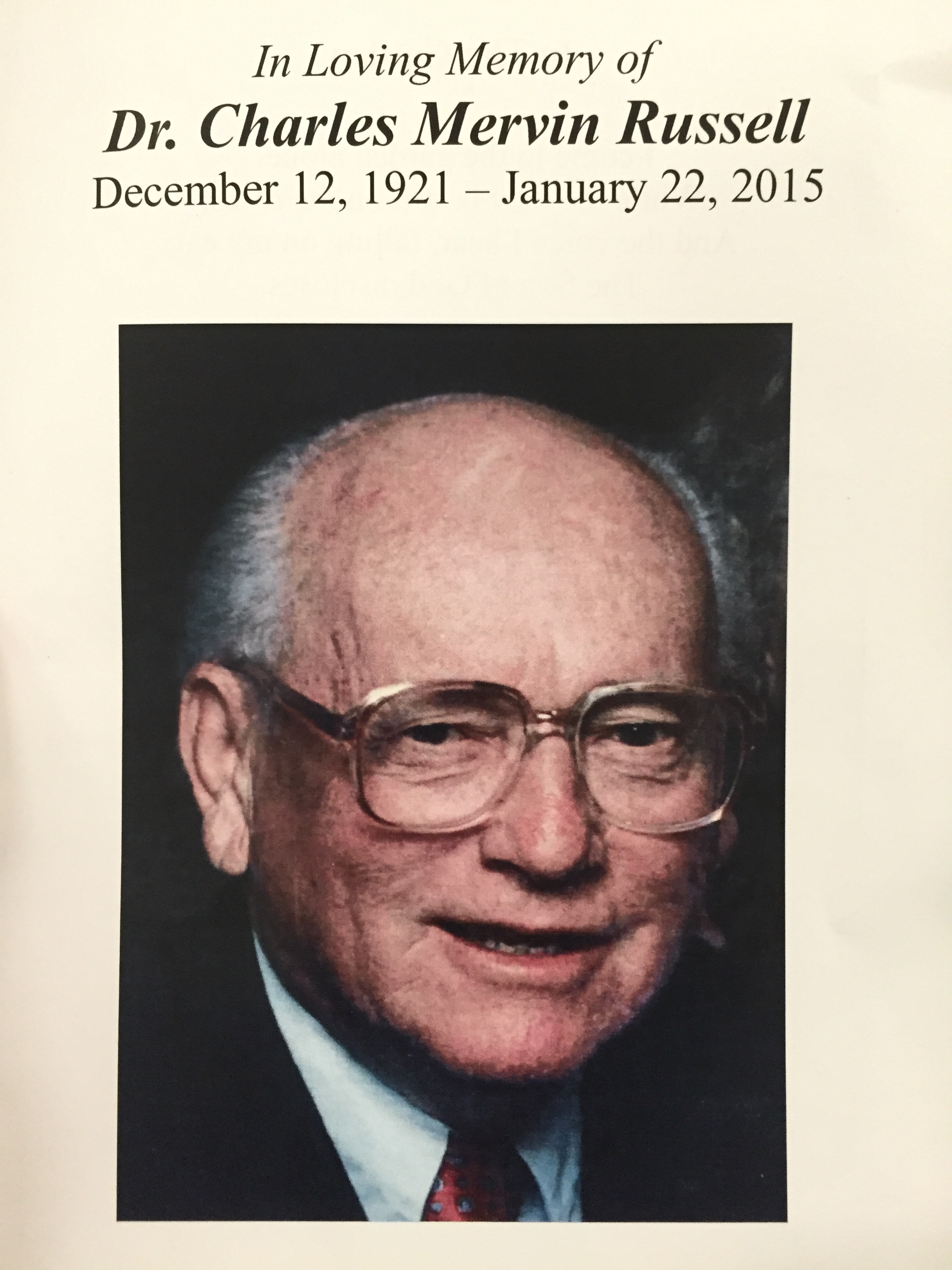
A Life Well-Lived: Remembering My Grandfather, Dr. Charles Mervin Russell

C. Mervin Russell

This past weekend we celebrated the life of my grandfather, Dr. Charles Mervin Russell. Grandpa lived a full life in his 93 years (December 12, 1921 – January 22, 2015).

As I have been reflecting on Grandpa’s life this past week, a friend drew my attention to a verse in Hebrews 13.

Remember your leaders, those who spoke to you the word of God.
Consider the outcome of their way of life, and imitate their faith
.”

– Hebrews 13:7

Grandpa Russell was one of the people in my life “who spoke to [me] the word of God.” Based on the verse above, I’m called to “remember” Grandpa, “consider” the outcome of his way of life, and to “imitate” his faith. I’m sure you can think of people in your life who have lived in such a way that you need to remember, consider, and imitate their lives as well.

As I remember the life of Grandpa, there is a lot to consider. Though I will not go into too much detail in this post, here are a few of the highlights.

Pastor, Youth Leader, Evangelist, Pilot

Grandpa was a pastor who served four Free Methodist churches in the Midwest. Grandpa was a youth leader who served as a regional director for the Free Methodist Youth. Grandpa was an evangelist who served as President of World Gospel Crusades and gave leadership to some 22 large scale crusades throughout the world. Grandpa was a pilot who used his skills for missions aviation work as founder and President of Mercy Airlift. As a pilot, grandpa logged over 6,000 hours flying through 23 different countries. His aviation career began in his early days with a Piper J-3 Cub to later days flying relief supplies to places as far as Ethiopia in Mercy Airlift’s DC-3.

A Passion for the People of the World

Grandpa’s love for the Lord and love for people compelled him to travel to over 69 countries in order to share the good news of the gospel and provide relief supplies to those hit by severe natural disasters and famine. He felt called to minister to both the physical and spiritual hunger in people’s lives, and did this faithfully throughout his life. Grandpa became a follower of Jesus in Lakeland, Florida. Shortly after becoming a Christian, as a teenager Grandpa share the good news of Jesus in his hometown by visiting every home in Palatka, Florida. This passion that began in Florida carried him on a journey of sharing the good news of the gospel with people throughout the United States and in as many as 69 countries.

Dr. Charles Mervin Russell lived his life well. It is a joy to remember this life. It is a joy to consider the outcome of his life. And, by God’s grace, I hope to imitate the faith that was alive and well in Grandpa’s many decades of life.

—————————

Interestingly, there is a powerful verse that immediately follows Hebrews 13:7 (the verse shared above).

Remember your leaders, those who spoke to you the word of God.
Consider the outcome of their way of life, and imitate their faith.
Jesus Christ is the same yesterday and today and forever
.”

– Hebrews 13:7-8

Because Jesus Christ is… because Jesus is the faithful one who is the same today as He was in the past and will be in the future… we can have confidence that He remains at work today in our lives.

As we consider those who have gone before us, the same God that guided and shepherded them in their lives is able to guide and lead us as well. And so, I remember Grandpa’s life, I consider the outcome of his life, and by God’s grace, I will seek to imitate the faith that was at work in his life as well.

C. Mervin Russell

C. Mervin Russell

Collaboration: The Benefits, Bottom Line, & Basics

Collaboration, by AJC1, Flickr

Collaboration, by AJC1, Flickr

In a previous post I focused on the importance of removing the “I’s” from teams. Certainly there are important barriers to effective teamwork that need to be addressed, but pressing through such barriers is worth the effort. Here is a quick overview of the benefits, bottom line, and basics of collaboration.

The Benefits of Collaboration

Engaging a related topic to teamwork—collaboration—a recent article in the Harvard Business Review highlights benefits to collaboration in the professional service sector. In this article, Heidi Gardner identifies collaborative work across expertise boundaries as a key path for addressing complex issues and increasing overall profitability. In this study, collaborative models were associated with increased margins, increased client loyalty, and increased competitive edge.

The Bottom Line of Collaboration

Emphasizing this point, Gardner writes: “For a firm, the financial benefits of multidisciplinary collaboration are unambiguous. Simply put, the more disciplines that are involved in a client engagement, the greater the annual average revenue the client generates.” Although there is a learning curve in moving toward collaborative practices, Gardner reminds readers that on this front “perseverance pays off.”

Although I see great value in the use of teams on multiple level, it is helpful to note that the collaborative edge of team practice also proves to be effective from an economic perspective.

The Basics of Collaboration

Gardner provides a few specific recommendations for those seeking to increase their use of collaboration.

  • Don’t squeeze your team members “…be fair to the partners you invite onto your team.”
  • Deliver what you committed to on time, without reminders.
  • Communicate openly.

While there are many factors that contribute to effective collaboration, these are helpful reminders. I appreciate the affirmation of collaborative practice in this piece by Gardner.

——————————————

How are you tapping in to the benefits, bottom line, and basics of collaboration in your work with others?

6 Challenges of Teams — Removing the “I’s” from Your Team

Join Our Team, by Craig Taylor, Flickr

Join Our Team, by Craig Taylor, Flickr

The use of teams and team-based structures in organizations continues to grow. Teams are associated with many benefits. One of my discussions on the benefits of teams is here (Groups vs. Teams: What’s the Difference?).

In addition to benefits, the use of teams also has challenges associated with it. We are told there is no “I” in team. Beyond individuals bringing a commitment to the team over themselves, I’d like to also share my short lists of “I’s” to remove from teams.

Ingrown: The first “I” to remove is the challenge of groups becoming ingrown. This is just another way to talk about the reality of “group think” that teams face.  When individual members of teams are not willing to speak up and make their perspectives known, this passive posture of team participation can work against innovation and creativity. In contrast to the dynamic of group think, team members need to be willing to challenge one another’s ideas and pursue new insights, new discoveries, and new innovations as they seek to pursue the team mission.

Indecision: The second “I” to remove is the challenge of indecision. In contrast to the point above, sometimes groups are characterized by sharing many new perspectives and ideas, but the open-ended process of idea generation never translates into decision. This can translate into a form of creative paralysis for teams—always generating new ideas and perspectives, but not making decisions on the questions the team is facing.

Inaction: The third “I” to remove is the challenge of inaction. This “I” of inaction can be a result of several factors. Inaction can be a result of the indecision noted above. But at times inaction is not about indecision but rather lack of fortitude or conviction in moving from decisions to action as a team. Inaction can also be due to lack of role clarity. When assumptions are made and people do not bring clarity and commitment to their role in moving toward actions, these assumptions can also result in inaction. Teams must gather a broad range of perspectives as they resist group think, and then they must land on decisions, clarify team member roles in light of these decisions, and then be willing to act on these decisions as they work toward the teams mission together.

Inefficiency: The fourth “I” to remove is the challenge of inefficiency. As identified in a previous post (Groups vs. Teams: What’s the Difference?), team process often can take longer than working as an individual or in a group process that simply brings together individual work. However, teams benefit from limiting this dimension of inefficiency. Although teams can take longer, it is important to maximize efficiency as the team pursues quality in its common work.

Inequity: The fifth “I” to remove is the challenge of inequity. If you’ve ever participated in a group project over the course of your schooling process, it is common for there to either be an uneven workload distribution or an uneven effort given to the workload of the team. This is an issue of equitable workload. Teams want to have team members that are full participants—team members that fully show up and engage the team process. Removing the “I” of inequity requires that team members are willing to hold one another accountable and call underperforming members to step up in their commitment to the team’s common work.

Inconsideration: The sixth “I” to remove is the challenge of inconsideration. When people come together in group and team processes, there is significant opportunity for conflict and dissention to emerge. Some of this conflict is substantive in nature—team members disagreeing over their ideas and perspectives. Other conflict is relational in nature—team members disagreeing over personal matters related to the interpersonal dynamics. Whether substantive or relational, a key solution to such conflict is consideration among the team members. Rather than engaging with inconsideration, effective teams care for one another. They care for the ideas of other members of the team. They care about the health of relationships on the team. They understand that erosion of team cohesion due to either substantive or interpersonal conflict is a threat to the health of the team and the team’s capacity to care out their mission.

——————

We are told “there is no I in Team.” This is a helpful reminder that team members need to primarily be about the needs of the team rather than their own self-interest. However, there are many other “I’s” that need to be removed as well. Teams need to face and remove the “I’s” on their teams—they need to remove the dynamics of tending toward the I behaviors of Ingrown, Indecision, Inaction, Inefficiency, Inequity, and Inconsideration.

How is your team doing? Are there any lingering “I’s” to remove in your team?

We Are All in This Together — Reflections on the National Prayer Breakfast

Ethiopia: Innocent Prayers of a Young Child, By Steve Evans, Flickr

Ethiopia: Innocent Prayers of a Young Child, By Steve Evans, Flickr

This past week I had the pleasure of attending the 63rd National Prayer Breakfast in Washington, DC. The National Prayer Breakfast has a long history representing the important role that faith plays in American life. Engaging the breadth of the United States, delegates were present from all 50 states.

Global Presence

But the National Prayer Breakfast is not limited to delegates from the United States. Representatives were present from 130 nations. This group of nearly 5,000 gathered together with members of Congress and President Barack Obama to do something quite unique in public life in our day—to reflect together on the person of Jesus of Nazareth and His teaching and also to ask God’s blessing and favor in the affairs of our world.

Diverse Sectors

In addition to representation from around the globe, the composition of the group also drew upon a diversity of sectors. Flourishing societies are built upon a foundation of multiple sectors working together in productive and meaningful ways. Key sectors in the United States are government, the market economy, and private/voluntary organizations.

A healthy and balancing relationship among government, market economy, and private sectors is vital for our future vitality and health as a society, and I’m reminded afresh that we are all in this together. The National Prayer Breakfast provides a place to come together from these multiple sectors to reflect on how Jesus and His teaching shape the manner in which we engage our work in each of these areas of society. Additionally, the National Prayer Breakfast represents a unique context in which people build relationships and pursue pathways for serving the people of our nation and world as we ask for God’s favor in this vital journey together.

The Experience

The experience of the National Prayer Breakfast is unlike any I’ve had previously. We heard from a wide range of speakers including President Obama, world-champion boxer Manny Pacquiao, NASCAR legend Darrell Waltrip, former Mayor and Ambassador to the United Nations Andrew Young, and many others. We heard written remarks shared from voices as diverse as Pope Francis and King Abdullah of Jordon. And I had the opportunity to share personal interactions with a unique and wide range of individuals such as Manny Pacquiao’s friend and pastor, actor Stephen Baldwin, a best-selling author, and an elected official from my home state.

Perhaps the most meaningful personal interaction was with Doug Coe, the man who sought out President Eisenhower over 60 years ago to paint a vision for leaders around the world praying together around a focus on the person of Jesus and His teachings. Doug’s vision, persistence, and trust in Jesus has led to 63 national prayer breakfast gatherings and pointing thousands of lives around the world to gather in the name of Jesus even though coming from a wide range of religious, political, and national backgrounds.

From Global to Local

Although it was amazing to hear from and interact with such a unique group of people in this global gathering, the key takeaway for me was sharing this experience with individuals from my home state and home city. The experience was deeply meaningful and was a call to pursue, foster, and engage in deeper relationship with my neighbors around the person of Jesus Christ. This provides great hope for our region as we engage very real challenges and pray, work, and collaborate together toward the aim of serving and blessing the world in Jesus’ name.

Oikonomia — Work as Stewardship

Work [Explored], by Riccardo Cuppini, Flickr

Work [Explored], by Riccardo Cuppini, Flickr

In January I attended a conference put on by the Oikonomia Network. Oikonomia is a Greek term used in the New Testament to describe the concept of stewardship and the appropriate management or administration of the resources of a household. Oikonomia is also a root word behind the English word economy, and points us to the connection between healthy economy and healthy stewardship of work in relationship with others.

The Intrinsic Value of Work

This conference for professors and theological educators is a place for those teaching or administrating in seminaries to come together and engage the priority of affirming the significance and goodness of work within our world and within our economies. Rather than work only having utilitarian benefits (i.e., just a way to bring home a pay check), there are significant theological reasons to affirm the intrinsic value of work in addition to the utilitarian value of work.

Most individuals engaged in everyday work feel the toil and struggle involved with work. Among the consequences of sin in our world is the reality of pain and toil in labor and work. But from a biblical perspective, it is important to remember that work was a part of the fabric of our world before the fall of humanity into sin.

God as Worker

In Genesis, the first description we read of God is his role as Worker and Creator:

  • In the beginning, God created the heavens and the earth” (Genesis 1:1), and
  • on the seventh day God finished his work that he had done, and he rested on the seventh day from all his work that he had done” (Genesis 2:2).

God not only worked in the beginning, he also continues to work:

  • all things were created through him and for him. And he is before all things, and in him all things hold together” (Colossians 1:16-17), and
  • he is the radiance of the glory of God and the exact imprint of his nature, and he upholds the universe by the word of his power” (Hebrews 1:3).

Workers in God’s Image

While God is described in the Bible as one who worked and continues to work, the Bible also describes humans as made in his image. Part of this image of God is our identity as those who work. A core dimension of being human is that we also create and work. And, it is important to remember that this core was a reality for humanity before the image of God in us was ever distorted by sin. Note the description of Adam’s work in the garden before the fall into sin was a reality: “The Lord God took the man and put him in the garden of Eden to work it and keep it” (Genesis 2:15).

Working with Excellence

Though work was a part of the human story before humanity’s fall into sin, sin’s presence now affects our work. What once was joyful stewardship of God’s creation now is accompanied by toil and pain. But God is in the business of redeeming what is broken. This includes the process of redeeming work.

In light of such gospel transformation, God’s people are part of the redemptive story in the area of their work as well. Through our work, we serve others within God’s household—the broader context of the world in which we live. Through our work, we both serve others and honor God. Note the New Testament call to work with excellence, as one serving the Lord directly: “Whatever you do, work heartily, as for the Lord and not for men, knowing that from the Lord you will receive the inheritance as your reward. You are serving the Lord Christ” (Col. 3:23-24).

Stewarding Our Work Well

Stewardship—oikonomia—is a helpful frame through which to consider the broader meaning of our everyday work. Certainly leadership is one context for stewardship. Leaders serving with a stewardship mindset recognize that their role is not simply about making decisions regarding their own resources, but rather making decisions that consider the needs of others and effectively stewarding the resources of the organization in a manner that considers the interests in which others are vested.

But in addition to leaders leaders, viewing our work under the leadership of God means that all workers have a stewardship responsibility. If we believe what the Bible says about God—“The earth is the Lord’s, and everything in it, the world, and all who live in it” (Psalm 24:1)—then all workers have a stewardship responsibility in their work to faithful care for and steward the resources of God’s household well.

—————————-

What are the resources that have been entrusted to you? What are the skills, talents, and abilities you’ve been given? How are you using your work as a pathway for stewarding both who you are and what you have in service of others and contributing within the wider economy within which you live and work? Work is a primary context for living as stewards. May this vision of oikonomia give you renewed energy to lead, serve, and work as stewards in God’s household—the world within which we live.