4 Top Leadership Priorities

Priorities_Washington State House

Photo Credit: Priorities, by Washington State House…, Flickr

I’m grateful to teach in an area of study I thoroughly enjoy. My primary role is serving as Professor of Ministry Leadership at Bethel Seminary. While every job has aspects that require work that is not explicitly enjoyable, I’m thankful that a majority of what I get to do also is personally enjoyable and fulfilling.


When I consider the core of what I teach about leadership, the focus of my teaching revolves around four leadership priorities. Here is an overview of these priorities.

1 – Servant Leadership and Follower Focus

How do your prioritize your commitments and practices as a leader? Servant leadership is an approach to leadership that prioritizes followers over leader self-interest. While many leadership thinkers would argue a commitment to organizational goals must be prioritized over the people of the organization, a servant leadership perspective argues that the most effective way to accomplish organizational commitments is through focus on followers. By focusing on followers, these followers are then able to deliver exceptional products or services to those the organization as a whole serves.

While the organization as a whole needs to be externally focused (serving its customers, constituents, or mission), the primary focus of the leader must be on serving and caring for the followers who are directly responsible for fulfilling the organization’s mission. I point my students to the importance of servant leadership practice and follower-focus in their leadership work. This leadership commitment is about prioritizing follower-focus and empowering followers for service of the mission.

2 – Transformational Leadership and Organizational Transformation

Complementing the follower-focus of servant leadership, transformational leadership is about creating broad and intrinsic ownership of the organization’s mission by leaders and followers alike. Transactional leadership is primarily based on a leader-follower exchange that incentivizes followers through extrinsic motivators. In contrast, transformational leadership is based on a leader-follower engagement that motivates followers intrinsically. Transformational leadership is about engaging followers in such a way that leaders and followers are mutually committed the organization’s mission and are willing to undergo transformational change with organizational goals in view.

3 – Team Leadership and Collaborative Orientation

In addition to servant and transformational leadership principles, I also advocate for collaborative and team-oriented approaches to leadership. Collaborative approaches to leadership and the use of teams recognizes and affirms that great wisdom exists within the people of organizations. Rather than providing an overly directive or top-down approach to leadership, collaborative and team-oriented approaches to leadership harnesses the wisdom and insights of the people on teams. This leadership commitment is about leveraging team wisdom and utilizing collaboration toward the end of decentralizing authority and empowering people to effectively carry out local work.

4 – Purpose in Leadership and Meaning-Based Living

Finally, I point students to the importance of meaning and purpose in their approach to leadership. On this point, Eisenberg and Goodall write that, “employees want to feel that the work they do is worthwhile, rather than just a way to draw a paycheck,” and to see work as, “a transformation of its meaning—from drudgery to a source of personal significance and fulfillment.” While employees bear responsibility for personally engaging their work with purpose, leaders play an important role in helping organizational members understand why the work they do matters. This leadership commitment is about being purpose-motivated and infusing both our personal work and the work of others with whom we work with meaning and significance.


In both my masters and doctoral level classes, my leadership courses are infused with each of these threads. This provides an overview of each, and I intend to take up each one in a bit more detail in future posts.

What are your leadership priorities? How do your priorities and commitments line up with these four principles? Take some time to share your priorities and thoughts below.

Easter, The Gospel, & Virtuous Leadership

Justin Irving's avatarPurpose in Leadership

Peeps, Mike Mozart, Flickr Peeps, Mike Mozart, Flickr

Easter week is just around the corner as I write this post. At the heart of Easter is the message of the gospel. In this brief post, I’d like to make some connections between the core message of Easter and leadership practice.

Ethics matter for those working in at diverse organizational levels. But ethics especially matter for leaders.

We want to know that what our leaders say is true. We want to see that the actions of our leaders are consistent with what they say as leaders.

General Ethical Approaches

Though certainly an oversimplification of ethical theory, we can argue that there are three primary approaches to ethics:

  • Virtue Ethics
  • Duty Ethics
  • Utilitarian Ethics

Here is a brief overview of these approaches drawn from an article I wrote with a colleague:

 Virtue EthicsDuty EthicsUtilitarian Ethics
Key operational questionWho ought I to…

View original post 630 more words

Why Ordinary is Extraordinary

The greatness of art..._Nick-Kenrick

Photo Credit: The greatness of art…, by Nick Kenrick, Flickr

A couple weeks ago a friend and former colleague of mine shared a message entitled, “In Praise of Ordinary Work.” For those with 30 minutes to spare, listening to the message would be well-worth your time as you think about your context of ordinary work.

Along the lines of what Chris Armstrong shares in this message, I’ve been pondering afresh the extraordinary value of the ordinary parts of life. In our celebrity-oriented culture, the ordinary is often overshadowed by what we view as extraordinary.

Enjoying the Extraordinary

Don’t misunderstand me. I love to see greatness shine through in others. For instance, if you’re a basketball fan, it’s been a fun year watching Stephen Curry break 3-point records. It is a delight to watch “extraordinary” talent in the likes of someone like Curry.

My point is not to belittle extraordinary work on the public stage, but rather to lift up the extraordinary work that happens in ordinary and private ways on a daily basis.

Enjoying the Ordinary as Extraordinary

For most of us, our life and work happens on smaller stages. But that does not make our lives any less extraordinary when they are lived out steadily and faithfully. As individuals, families, and a society, we flourish together we collectively live our “ordinary” lives in an extraordinary manner.

When I look around, those I value most in my life are those that are steadily and faithfully attending to their lives and work on a daily basis.

Great things come when children faithfully apply themselves to the work before them in study and practice. Great things come when spouses and friends provide loving support for those closest to them. Great things happen with coworkers support their team in the accomplishment of collective work goals. Great things happen when we live out the ordinary in an extraordinary way.

In the Bible, we read the following call:

“…make it your ambition to lead a quiet life: You should mind your own business and work with your hands, just as we told you, 12 so that your daily life may win the respect of outsiders and so that you will not be dependent on anybody.
– 1 Thessalonians 4:11-12

That is quite an affirmation of the ordinary.

Whether the stage of your life is small or large in its scope, we are all called to attend to the ordinary work that is in front of us. We are called to live our “ordinary” lives in light of what they actually are—extraordinary.

What is the ordinary work you are called to do in an extraordinary way today? What is the ordinary work being done by others around you in an extraordinary way today? Take some time to notice and appreciate the extraordinary that is all around you.

#1 … Top 10 Posts from 2015 — Let Your Life Speak — How to Understand Your Vocational Call

Artist at work_Jean-Francois Phillips

Photo Credit: Artist at work, Jean-Francois Phillips, Flickr

I have been sharing my top blogs posts from 2015. It’s time for #1!

The #1 post from 2015 was …

Let Your Life Speak — How to Understand Your Vocational Call

Interestingly, this “top post” received twice as much interest as the next closest post last year. This likely speaks to many realities, not the least of which is how much people are interested in discerning their sense of vocation and calling. We want to be about work that matters. We want to carry out this calling in a manner that let’s our life speak.

So, how do you discern your vocational path? How do you decide what your contribution to the world will be? What is your vocational calling?

These are big questions. How we understand our work and the contribution we make to the world is vital from our earliest days of vocational discernment on through adulthood.

  • It is vital for teens as they consider potential pathways for further education and future work.
  • It is vital for adults as they work to make ends meet for their family, and particularly as they seek to do so in a manner that is fulfilling to them personally and meaningful to others societally.
  • It is vital to all engaged in any form of vocation because our work lives occupy the majority of our waking hours.

Understanding the importance of vocational discernment is one thing. Understanding how to approach this process of vocational discernment is quite another.

I invite you to reflect on your process of vocational discernment as you engage Purpose in Leadership’s #1 post from 2015…

Let Your Life Speak — How to Understand Your Vocational Call

#2 … Top 10 Posts from 2015 — 7 Levels of Leadership Communication

Communication

Photo Credit: Communication, by elycefeliz, Flickr

In a previous post I shared some observations on my top blogs posts from 2015. This week we come to the top two posts.

The #2 post from 2015 was …

7 Levels of Leadership Communication

Effective leadership and effective communication are intimately connected. I often tell students, “Although you can be an effective communicator without being an effective leader, effective communication is foundational to effective leadership.”

For some of you, this is energizing. For others—perhaps those who do not like public speaking—this can sound intimidating. But whether we like it or not, effective communication is vital for effective leadership.

It is important to remember, however, that communication takes many forms, uses many mediums, and happens at many levels. While some leaders excel at public forms of communication such as plenary speaking or communication through mass media, others excel at interpersonal forms of dyadic and small group communication.

As leaders, the key is to know our strengths and growth edges as leadership communicators.

Check out this top post (both in 2014 and 2015) and a quick list of 7 Levels of Leadership Communication that you may use to think through strengths and growth edges in your leadership communication practice.

Here’s the link to the Purpose in Leadership’s #2 post from 2015:

7 Levels of Leadership Communication

#3 … Top 10 Posts from 2015 — Leading from the Front … Leading with Vision

Olivier Carré-Delisle_Leadership vs Management

Leadership vs. Management, on Flickr

In a previous post I shared some observations on my top blogs posts from 2015. In the coming weeks I will be taking time both to share new content and to share some of the top viewed posts from the past year.

The #3 post from 2015 was …

Leading from the Front … Leading with Vision

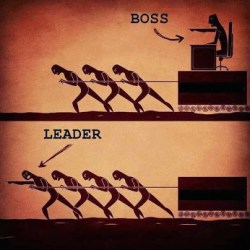
Leading from the front requires leading with vision!

Engaging the question, “Why does vision matter?” Burt Nanus offers the following reflection:

Vision is the main tool leaders use to lead form the front. Effective leaders don’t push or production their followers. They don’t boss them around or manipulate them. They are out front showing the way. The vision allows leaders to inspire, attract, align, and energize their followers—to empower them by encouraging them to become part of a common enterprise dedicated to achieving the vision.

In this brief post I encourage you to consider whether you’re leading from the front or whether you’re leading from behind. Are you calling people to an inspiring vision of what can be, or are you pushing and prodding followers to do what they really are not committed to already?

Vision helps to motivate followers intrinsically rather than extrinsically. Vision helps to lead from the front!

Here’s the link to Purpose in Leadership’s #3 post from 2015

Leading from the Front … Leading with Vision

Harnessing the Hope of Humility: Timeless Wisdom for Today

basin_Flood G.

Photo Credit: basin, by Flood G., Flickr

In seasons of political posturing, humility rarely is modeled by current and aspiring politicians. But into such seasons, the hope of humility stands in stark contrast and calls for us to harness this hope for the good of our communities

In this post, let’s journey back to the time of Jesus Christ in order to explore the timeless wisdom of servant-hearted humility.

A Mother’s Request

Nearly 2000 years ago, a mother motivated by love for her boys made a request. She asked Jesus to allow her sons to sit in the places of honor at His right and left in His kingdom. As might be expected, the other ten disciples did not look favorably on this parental power play.

But Jesus harnessed the occasion as an opportunity to teach a kingdom reality: “You know that the rulers of the Gentiles lord it over them, and their high officials exercise authority over them. Not so with you. Instead, whoever wants to become great among you must be your servant” (Matthew 20:25-26).

We find here a profound reality in Jesus’ teaching—humility in the form of service is at the heart of leadership in the economy of Jesus. One of my colleagues notes that at its heart, this passage is calling leaders to positions of low status and high service.

Actions Speak Louder than Words

The low status & high service motif of Jesus was not mere rhetoric, however. Jesus lived and modeled this principle. Take, for instance, one of the most powerful sermons ever—the sermon preached with a basin and a towel.

In John 13, we find Jesus at a Passover feast with His disciples. With divine audacity, Jesus rises from the meal, wraps a towel around his waist, and stoops low, with heavenly humility, as He begins to wash His disciples’ feet. We see in this amazing account the words of Jesus made alive: “…the Son of Man did not come to be served, but to serve, and to give his life as a ransom for many” (Matthew 20:28). Jesus lived the kingdom principle of low status & high service.

The Hope of Humility

The timeless teaching of Jesus that modeled and called His followers to leadership marked by low status and high service stands in stark contrast the inverted high status and low service motif modeled by so many leaders in our day. What such leaders fail to realize, however, is that in the case of humble service it is not only good wisdom but also good business.

Jim Collins, author of Good to Great asks, “What catapults a company from merely good to truly great?” His answer is refreshing—leaders who combine fierce resolve and humility are key.

It’s often viewed as counter-intuitive. Usually humility is associated with pushovers rather than leaders of great companies. But amazing as this is, biblical humility is just what the cultural and corporate doctors have ordered.

Harnessing the Hope of Humility

So how is the hope of humility to be harnessed?  Let me offer three “prescriptions.”

Prescription 1: Be an Apprentice in the School of Humility

The first prescription is to be an apprentice in the School of Humility. Humility is by its very nature something that is learned through participation. 2 Chronicles 7:14 calls us to this apprentice-like participation: “If my people, who are called by my name, will humble themselves and pray and seek my face and turn from their wicked ways, then will I hear from heaven and will forgive their sin and will heal their land.” Harnessing the hope of humility begins as a participating apprentice.

Prescription 2: Follow the Man from Galilee

In the School of Humility, our apprenticeship is under the Master Practitioner—Jesus, the servant from Galilee. When Jesus washed His disciples’ feet, He called them to a life-trajectory of humble service saying, “Now that I, your Lord and Teacher, have washed your feet, you also should wash one another’s feet” (John 13:14). Following the Master Servant furthers a harnessing of the hope of humility.

Prescription 3: Go to the Grace

The final prescription is simply this: Go to the grace. In 1 Peter 5:5, Peter writes, “God opposes the proud but gives grace to the humble.”  Do you wish to harness the hope of humility?  Go to God’s graceful place of humility. You’ll be glad you did.


It’s difficult to imagine how one person’s actions of humility and service could change the course of history, but this is exactly what happened through the life of Jesus as He began to turn the world right side up. Applying these prescriptions will help us begin the process of aligning the course of our lives with His. Applying these prescriptions will help us to harness the hope of humility.

#4 … Top 10 Posts from 2015 — Groups vs. Teams: What’s the Difference?

Working Together Teamwork Puzzle Concept, Scott Maxwell, Flickr

In a previous post I shared some observations on my top blogs posts from 2015. In the coming weeks I will be taking time both to share new content and to share some of the top viewed posts from the past year.

The #4 post from 2015 was …

Groups vs. Teams: What’s the Difference?


I love Shidle’s observations about teams…

A group becomes a team when each member is sure enough of himself
and his contribution to praise the skills of the others.”

– Norman Shidle

Most people participate in some form of a team or group on a regular basis. This happens through recreation in the realm of sports and clubs. This happens on the job as people come together to get things done within organizations.

Although you likely have been part of both groups and teams in the past, do you understand the difference? What are the key distinctions between a group and a team?

Check out this top post (both in 2014 and 2015) regarding the difference between groups and teams. Here’s the link to the Purpose in Leadership’s #4 post from 2015:

Groups vs. Teams: What’s the Difference?

Purpose in Leadership on Patheos

Faith-Work

I’m excited to point you toward another channel through which I’ll be sharing thoughts. The Purpose in Leadership blog was invited to join the Patheos Faith and Work Channel, and this will allow me to share the type of reflections offered on this blog with a wider audience. I’ll continue to post regularly through both Purpose in Leadership blogs.

—  Purposeinleadership.com Blog
—  Patheos Purpose in Leadership Blog

As a faith-based blog channel focused on the integration of faith and work, I will be regularly sharing posts on leadership, work, and vocation.

Here is a highlight of the last five posts shared through the Purpose in Leadership blog on Patheos. Enjoy!

#5 … Top 10 Posts from 2015 — 9 Effective Leadership Practices


Number Nine_Mario-Klingemann

Number Nine, by Mario Klingemann, Flickr

In a previous post I shared some observations on my top blogs posts from 2015. In the coming weeks I will be taking time both to share new content and to share some of the top viewed posts from the past year.

The #5 post from 2015 was …

9 Effective Leadership Practices

Servant leadership is a good idea. The core of servant leadership is about leaders placing follower needs at the highest priority level. Most would agree this is a good idea. The question many do raise, however, is whether or not this good idea is also effective?

Thankfully social science research methods can help us. One of the benefits of social science research is its capacity to confirm the utility or effectiveness of practices that are inherently valid philosophically or biblically.

Good Ideas that Work

For instance we do not need research to inform us that humility is important for individuals and leaders; this is an argument that may be made practically, philosophically and biblically. The validity and importance of humility may be argued apart from research. However, research can come alongside logic and experience to confirm the utility or effectiveness of an idea like humility. This is what was found by Jim Collins in his research on Level Five Leaders. Not only is leader humility ethically-good and biblically-consistent as an idea—an argument that may be made biblically, philosophically, and practically—Jim Collins found through research that leader humility is also effective.

Here’s a link to the Purpose in Leadership #5 post from 2015:

9 Effective Leadership Practices